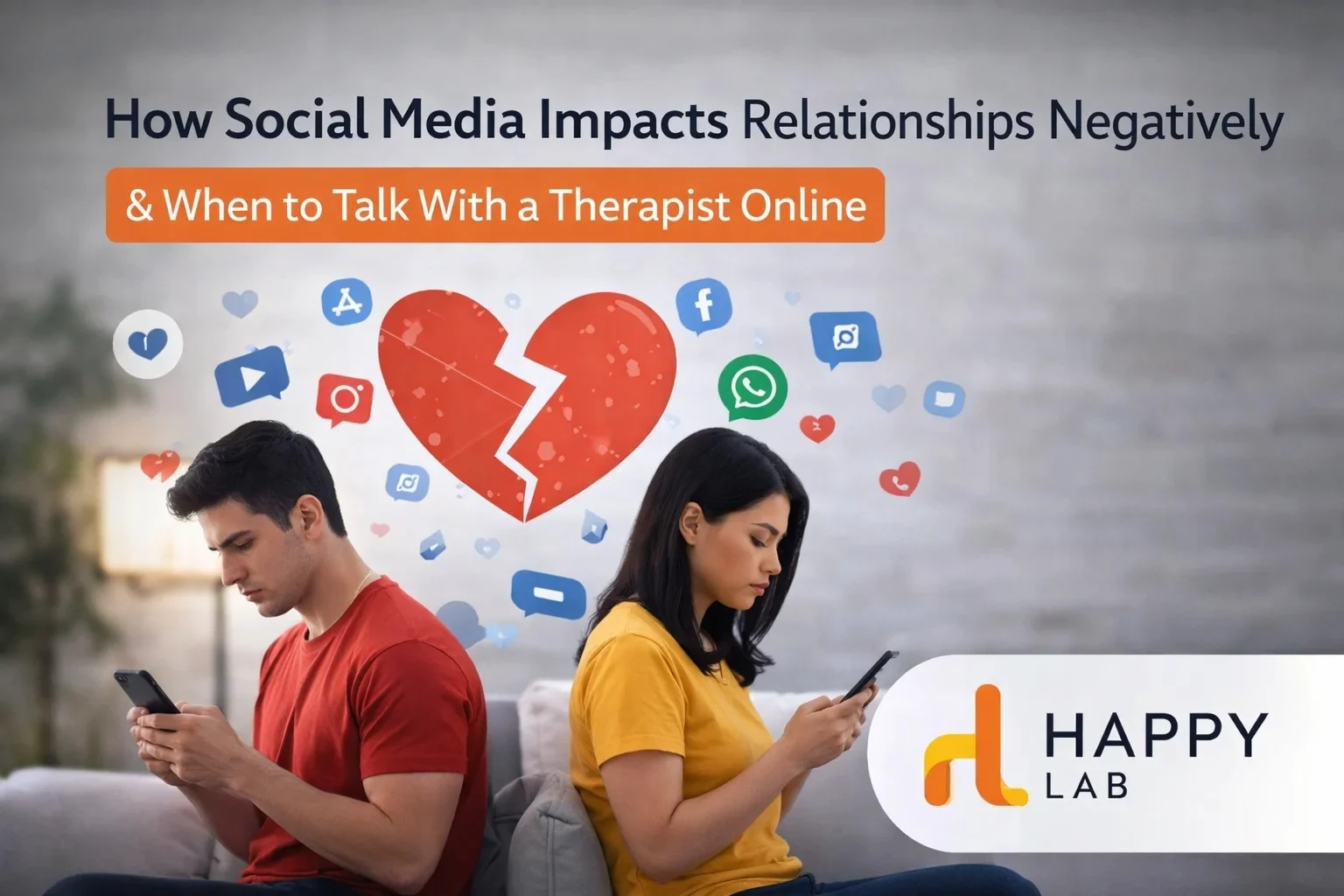
How Social Media Impacts Relationships Negatively
Let me ask you something honestly…
When was the last time you sat with your partner without checking your phone even once?
Not easy to remember, right?
Social media has quietly become a third person in most relationships. It doesn’t argue, it doesn’t speak—but it influences everything. From how we think to how we react, it shapes emotions in ways we often don’t even notice.
At first, it feels harmless. You share memes, send reels, tag each other in posts. But slowly, things change. Conversations become shorter. Expectations become unrealistic. Doubts start creeping in.
It’s like inviting a guest into your home who never leaves—and slowly starts controlling the environment.
This article breaks down the social media impact on relationships, why it happens, how it affects you emotionally, and when it’s time to talk with a therapist online before things go too far.
What Makes Social Media So Powerful?
Social media is no app, it is created to make you addicted.
Each scroll, each notification, each like is meticulously constructed to catch your eye. And the more time you spend on-line, the less time you spend connecting in the real world.
Here’s the problem:
Relationships require presence rather than availability.
Online does not imply an emotional connection.
How Relationships Have Changed in the Digital Era
Think about relationships 10–15 years ago.
- More face-to-face conversations
- Less distraction
- More patience
Now?
- Instant replies expected
- Online activity monitored
- Silence misunderstood
The impact of social media on relationship dynamics is huge. Expectations have changed, but emotional maturity hasn’t caught up.
The Comparison Trap: “Why Isn’t My Relationship Like That?”
You’re scrolling Instagram…
You see a couple traveling, laughing, surprising each other…
And suddenly, your relationship feels “less”.
This is one of the biggest effects of social media on relationships.
Why This Happens:
- You see curated highlights, not reality
- You compare your worst days to someone else’s best moments
- You start expecting unrealistic standards
Truth: No relationship is perfect. Social media just edits out the struggles.
Jealousy, Insecurity, and Digital Doubts
“Who is that?”
“Why did you like their photo?”
“Why were you online but didn’t reply?”
Sound familiar?
Social media creates micro-triggers that lead to big conflicts.
Common Triggers:
- Late replies
- New followers
- Comments from unknown people
- Hidden chats
This leads to insecurity, and insecurity slowly destroys trust.
Communication Breakdown in the Smartphone Age
You’re together—but not really talking.
- One person scrolling reels
- One person checking messages
- Conversations reduced to short replies
Over time, meaningful communication disappears.
And without communication, even strong relationships weaken.
Emotional Disconnection Despite Constant Connectivity
Ironically, we are more connected than ever—but feel more disconnected.
You may talk all day online, but still feel:
- Unheard
- Unseen
- Unimportant
That’s because emotional connection needs depth—not just frequency.
The Addiction to Likes, Comments, and Validation
Let’s be real.
Posting something and waiting for likes feels exciting.
But when validation comes from strangers instead of your partner, priorities shift.
Signs of Validation Addiction:
- Checking likes repeatedly
- Feeling upset when posts don’t perform
- Seeking attention online
This creates emotional imbalance in relationships.
Social Media and Emotional Cheating
Cheating isn’t always physical anymore.
It can be:
- Flirting in DMs
- Sharing personal thoughts with someone else
- Hiding conversations
This is called emotional cheating, and it hurts just as much.
Privacy vs Oversharing in Relationships
Some couples share everything online.
Others prefer privacy.
Problems arise when expectations don’t match.
Common Conflicts:
- “Why don’t you post me?”
- “Why did you share our personal moment?”
- “Why is our relationship public?”
Balance is key.
Mental Health and Relationship Stress
The social media influence on relationships goes beyond arguments.
It directly affects mental health.
Impact Includes:
- Anxiety
- Low self-esteem
- Fear of missing out (FOMO)
- Overthinking
And when mental health suffers, relationships suffer too.
Overthinking: The Silent Relationship Killer
One small thing online can lead to hours of overthinking.
Example:
- Seen at 10:00 PM
- No reply till 10:30 PM
Your mind creates stories:
“Are they ignoring me?”
“Are they talking to someone else?”
This cycle is exhausting and damaging.
Clear Signs Social Media Is Hurting Your Relationship
Watch Out for These Signs:
- Frequent fights about online behavior
- Feeling insecure due to social media
- Checking partner’s phone secretly
- Spending more time online than together
- Emotional distance increasing
If you notice these, it’s not “normal”—it’s a warning.
Practical Ways to Fix Social Media Damage
You don’t need to delete social media—you need to use it wisely.
Simple but Powerful Solutions:
- Set Clear Boundaries
- Decide what’s okay and what’s not
- Create No-Phone Zones
- Meals, dates, and bedtime
- Talk Openly
- Share insecurities without blaming
- Stop Comparing
- Focus on your relationship
- Prioritize Real Moments
- Spend quality time offline
When You Should Talk With a Therapist Online
Sometimes, things go deeper than you can handle alone.
You Should Seek Help If:
- Trust issues keep repeating
- Arguments never get resolved
- You feel emotionally disconnected
- Anxiety and overthinking are constant
Talking to a professional can change everything.
A trained therapist helps you:
- Understand patterns
- Improve communication
- Heal emotional wounds
How to Build a Healthy Digital Relationship
Healthy Habits That Work:
- Respect each other’s space
- Don’t stalk—trust instead
- Keep some moments private
- Focus on real-life bonding
Remember:
Your relationship is not a social media post—it’s a real-life experience.
Conclusion
The social media impact on relationships is subtle but powerful.
It doesn’t break relationships overnight—but slowly, quietly, consistently.
From comparison and jealousy to emotional disconnect and overthinking, the effects of social media on relationships can deeply affect your bond.
But awareness is your first step to change.
If you feel like things are getting out of control, don’t ignore it.
Why Choose Professional Help?
At Happy Lab – Counselling Therapy in India, you get access to:
- ✔️ Experienced therapists and psychologists
- ✔️ Personalized therapy plans
- ✔️ 100% confidential online sessions
- ✔️ Support for relationship issues, anxiety, and overthinking
- ✔️ Flexible sessions for working professionals
With over 3,000+ clients and a 97% satisfaction rate, Happy Lab is a trusted space for emotional healing and relationship growth .
Key Takeaways
Problem | Impact on Relationship | Solution |
Comparison | Dissatisfaction | Focus on reality |
Jealousy | Trust issues | Open communication |
Overuse | Less bonding | Digital detox |
Overthinking | Arguments | Therapy support |
Validation seeking | Emotional imbalance | Self-awareness |
Action Plan You Can Start Today
- Spend 1 hour daily without social media
- Have one real conversation daily with your partner
- Stop checking partner’s online activity
- Set clear social media boundaries
- Seek therapy if issues persist
Your relationship deserves more than likes and comments—it deserves understanding, time, and care.
If needed, take that step today and talk with a therapist online at Happy Lab.
FAQ'S
How does social media negatively affect relationships?
It generates comparison, jealousy, misunderstanding of communication and disconnection of feelings between couples.
Can social media cause trust issues?
Yes, such actions as liking, chatting, or hiding chats may result in suspicions and insecurity.
Is it normal to feel insecure because of social media?
It’s common, but not healthy. It can be managed with the help of awareness and communication.
How can couples reduce social media problems?
Putting limits, lessening screen time and engaging in real-life communication.
When should I talk to a therapist online?
In case such problems as overthinking, lack of trust, or emotional distance persist, professional assistance is necessary.