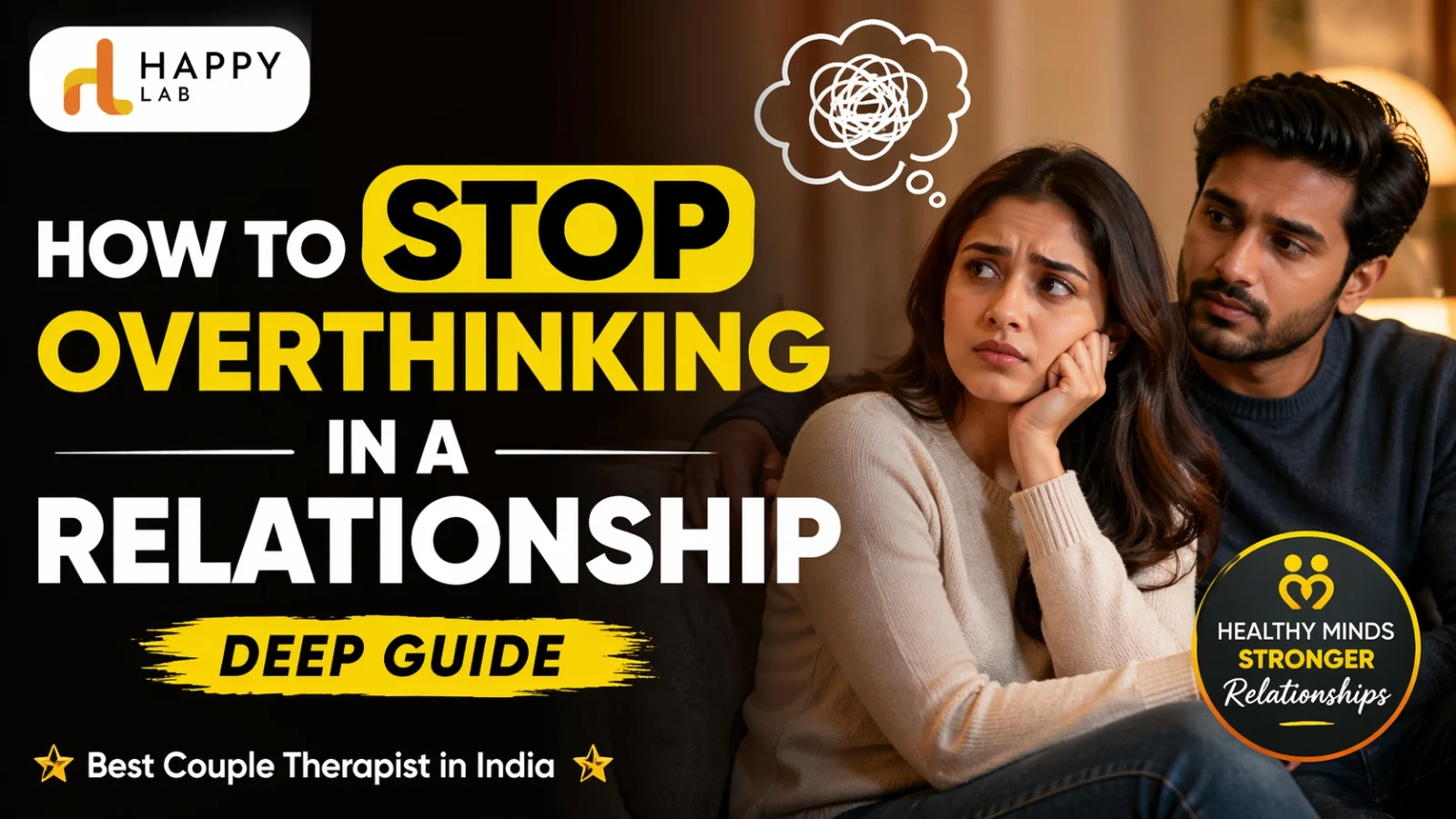
How to Stop Overthinking in a Relationship – Deep Guide by Happy Lab
“Why did they say that?”
“Why haven’t they replied yet?”
“Are they losing interest in me?”
If your mind constantly loops through these questions, you’re experiencing overthinking in a relationship and it can quietly destroy even the strongest emotional bonds.
Here’s the truth most people don’t realize:
Overthinking is not the real problem.
The pattern behind your thinking is the real problem.
You’re not overthinking randomly, you’re stuck in a relationship pattern loop.
And unless you break that loop, no amount of reassurance, love, or time will fix it.
That’s why modern, structured approaches like Happy Lab – Best couple therapist in India focus not just on talking but on identifying, mapping, and breaking patterns using proven frameworks.
In this detailed guide, you’ll learn:
✔ How to stop overthinking in a relationship
✔ Why your mind keeps creating false scenarios
✔ How to fix repeated conflicts and emotional loops
✔ Practical tools used in real couple counselling
What is Overthinking in a Relationship?
Overthinking in a relationship is when your brain creates meaning beyond reality.
Instead of responding to what actually happened, you react to what you think it means.
Example:
Partner: “I’m busy”
Your brain:
“They’re avoiding me”
“They don’t care anymore”
This is not reality. This is interpretation driven by fear.
The Root Cause: Pattern vs Problem
Most people think:
“We fight because of issues”
But the truth is:
You fight because of patterns
Key Insight:
Problem = Topic (money, time, in-laws)
Pattern = Reaction (blame, silence, defensiveness)
Until you fix the pattern, the problem will keep changing but the conflict stays the same.
Why Overthinking Feels So Real
Your brain is designed to protect you from emotional pain.
So it:
Predicts worst-case scenarios
Tries to find hidden threats
Overanalyzes behavior
Analogy:
Your brain is like a smoke alarm
It rings loudly even when there’s just a little steam.
Psychological Triggers Behind Overthinking
Major Triggers:
Fear of abandonment
Past relationship trauma
Low self-worth
Lack of emotional safety
Inconsistent communication
Trigger Breakdown Table
Trigger | Effect on Mind |
Past hurt | Expecting same pain again |
Low confidence | Doubting partner’s love |
Silence | Creating negative assumptions |
Conflict | Fear of relationship ending |
Signs You Are Stuck in Overthinking
Clear Indicators:
- You replay conversations repeatedly
- You analyze tone, words, and timing
- You feel anxious without clear reason
- You seek reassurance frequently
- You assume the worst quickly
If 3+ signs match, you are in a pattern loop.
The Overthinking Loop Explained
Step-by-Step Loop:
Trigger (late reply)
Thought (“Something is wrong”)
Emotion (anxiety)
Reaction (questioning, blaming)
Conflict
More overthinking
This loop repeats again and again.
How to Stop Overthinking in a Relationship (Step-by-Step)
Step 1: Identify the Thought
Ask:
“Is this fact or assumption?”
Step 2: Pause the Reaction
Don’t react immediately.
Step 3: Communicate Clearly
Replace guessing with asking.
Step 4: Regulate Emotion
Use breathing or grounding.
Step 5: Break the Pattern
Do something different than usual.
Communication vs Assumption: The Core Shift
Assumption:
“They don’t care about me”
Communication:
“I felt ignored earlier can we talk?”
Why This Works:
Reduces misunderstanding
Builds trust
Stops mental loops
The “Same Fight, Different Topic” Pattern
Have you noticed this?
You fight about:
- Texting
- Time
- Money
- Family
But the feeling is always the same
Pattern Table
Topic | Real Issue |
Late reply | Feeling unimportant |
Less time | Feeling disconnected |
Arguments | Lack of emotional safety |
Emotional Roles: Escalator vs Withdrawer
Every couple falls into roles:
1. Escalator
Pushes conversation
Expresses strongly
Seeks answers
2. Withdrawer
Avoids conflict
Shuts down
Needs space
This creates a loop:
More push → More withdrawal → More frustration
Tools to Break Overthinking Instantly
1. Thought Labeling
“This is just a thought, not reality”
2. Reality Check Method
Write:
What happened
What you assumed
3. 90-Second Rule
Let emotion pass before reacting
4. Grounding Technique
Focus on surroundings
5. Pattern Interrupt
Do something different (pause, walk, delay reply)
Daily Habits to Rewire Your Mind
Top Habits:
Journaling
Meditation
Exercise
Gratitude practice
Limiting social media
Habit Impact Table
Habit | Result |
Journaling | Clarity of thoughts |
Exercise | Reduces anxiety |
Gratitude | Improves mindset |
Sleep | Emotional balance |
Why Most Couples Stay Stuck
Reasons:
No awareness of patterns
Lack of tools
Emotional reactions
No structured guidance
Talking alone does not solve patterns.
Structured Couple Counselling: The Real Solution
This is where Happy Lab – Best couple therapist bangalore stands apart.
Instead of:
- Endless sessions
- Random advice
They offer:
Structured, measurable, evidence-based counselling
Happy Lab Relationship Reset Program Explained
What Makes It Different?
✔ Not open-ended therapy
✔ Clear 6–8 session pathway
✔ Measurable progress
✔ Evidence-based methods
Program Breakdown
STEP-1: Assess
Relationship measured across 5 pillars
STEP-2: Map
Identify exact pattern loop
STEP-3: Work
Learn tools (live practice)
STEP-4: Measure
Compare progress (Session 1 vs 6)
Program Features
Pillars Assessment
Pattern Mapping
Workbook
Progress Report
Therapist Support
100% Confidential
Comparison Table
Feature | Traditional Therapy | Happy Lab Program |
Structure | Open-ended | Defined |
Progress | Unclear | Measurable |
Tools | Varies | Proven frameworks |
Outcome | Uncertain | Goal-driven |
Conclusion – Stop Overthinking by Fixing the Pattern
Overthinking in a relationship is not your fault but it is your responsibility to fix it.
If you keep:
- Repeating the same fights
- Feeling anxious
- Doubting your partner
Then it’s not about the situation, it’s about the pattern you’re stuck in.
Why Choose Happy Lab – Counselling Therapy in India?
- ✔ Structured Relationship Reset Program™
- ✔ Gottman-trained experts
- ✔ Online & offline sessions
- ✔ Clear results and progress tracking
- ✔ Designed for real transformation
If you truly want to learn how to stop overthinking in a relationship, don’t just understand the problem fix the pattern with expert guidance.
Happy Lab – Best couple therapist in India helps you move from confusion → clarity → connection.
FAQ'S
How to stop overthinking in a relationship permanently?
By identifying your thought patterns, improving communication, and using structured counselling methods.
Why do I overthink in my relationship so much?
Due to fear, insecurity, past experiences, and lack of emotional clarity.
Can overthinking destroy a relationship?
Yes, if unchecked, it leads to conflict, mistrust, and emotional distance.
What is the fastest way to stop overthinking?
Pause, identify assumptions, and communicate directly instead of reacting emotionally.
Is couple counselling effective for overthinking?
Yes, especially structured programs like Happy Lab’s, which focus on patterns and measurable progress.
How do I stop overthinking my partner’s behavior?
Focus on facts instead of assumptions. Instead of analyzing every action, communicate openly with your partner and clarify your doubts directly.
Is overthinking a sign of insecurity in a relationship?
Yes, in many cases overthinking in a relationship is linked to insecurity, fear of rejection, or past emotional experiences that affect trust and confidence.
Can overthinking be controlled without therapy?
Mild overthinking can be managed with self-awareness, mindfulness, and communication. However, deep patterns often require structured counselling like Happy Lab’s approach.
How long does it take to stop overthinking in a relationship?
It depends on the individual and the depth of patterns. With consistent effort and guided counselling, noticeable improvement can happen within a few weeks.
What is the root cause of overthinking in relationships?
The root cause is usually emotional patterns such as fear, insecurity, lack of clarity, or unresolved past experiences—not the current situation itself.