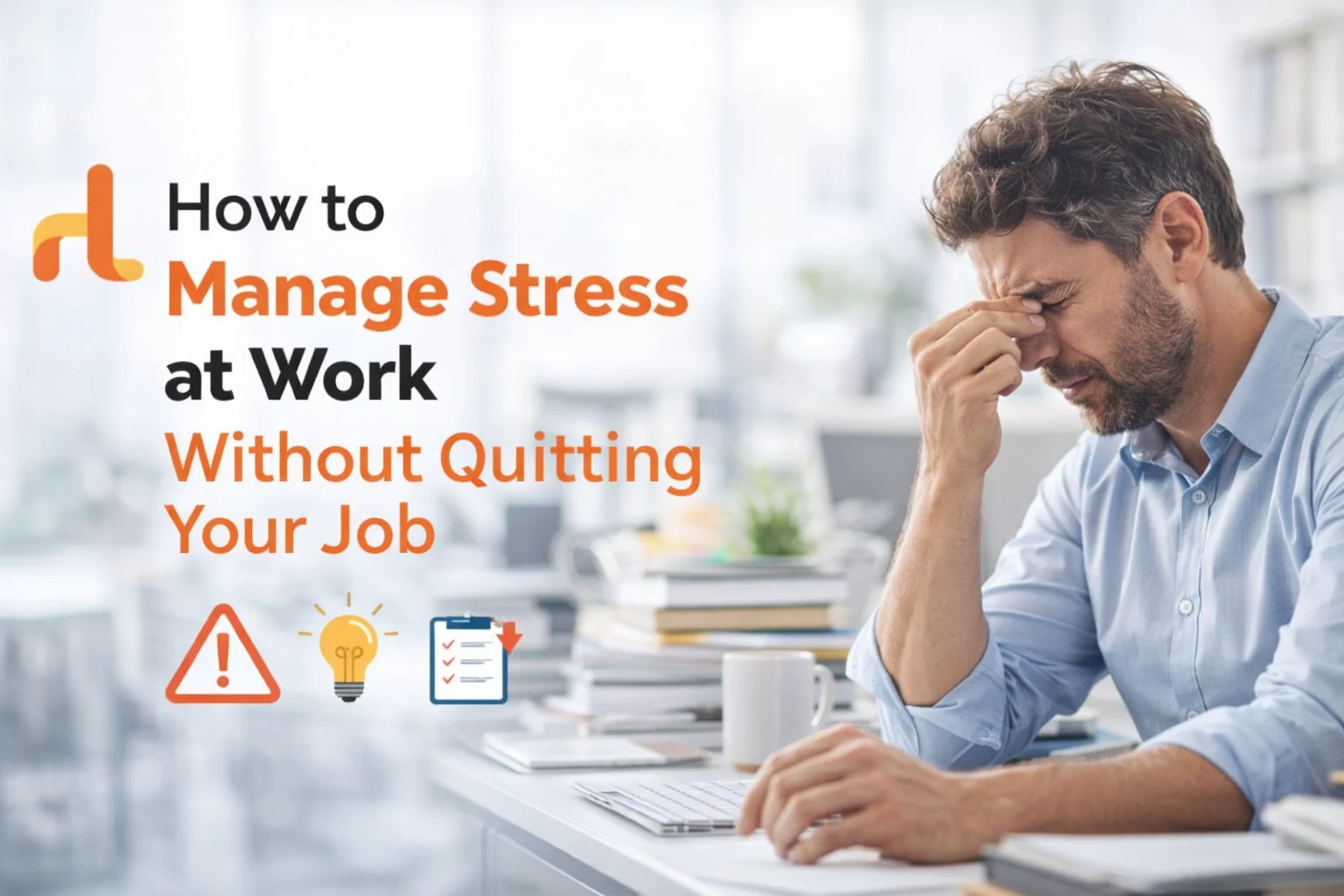
How to Manage Stress at Work Without Quitting Your Job (A Practical Guide for Real People)
Work stress may seem like background noise emails pinging at you, deadlines chasing you, expectations raising. Some days, it’s manageable. On other days, you feel like you are a small inconvenience at the point of saying, I quit.
You are not a weak person, in case you have been on the hunt to find out how to cope with stress in the workplace. You’re human.
The truth? The majority of the professionals do not really desire to leave their jobs. They desire that the pressure be decreased. They desire to be relaxed, honored, and bossy once again.
Visualize the work stress as a pressure cooker. Unless you get the steam out, it accumulates. However, you do not have to discard the cooker. You just need the right valve.
What Work Stress Really Is
Stress at work isn’t just “too much work.” It’s usually:
- Lack of clarity
- Fear of failure
- Feeling undervalued
- Lack of control
- Constant urgency
Your brain reacts to workplace stress the same way it reacts to physical danger. Heart rate increases. Muscles tighten. Thoughts race.
The problem isn’t stress itself. A little stress can motivate you. The problem is chronic stress when your body never gets a break.
Understanding this is the first step in learning how to manage stress at work.
Why Quitting Isn’t Always the Solution
It’s tempting to think:
“If I leave this job, everything will be fine.”
But here’s the uncomfortable truth if you don’t change how you handle stress, it may follow you to your next workplace.
Quitting can help in toxic environments. But often, stress patterns repeat.
So instead of running, ask:
- Can I improve my boundaries?
- Can I improve communication?
- Can I regulate my reactions better?
Sometimes growth happens without resignation letters.
Signs You’re Secretly Burning Out
Burnout doesn’t happen overnight.
Watch for:
- Constant exhaustion even after sleep
- Irritability at small issues
- Loss of motivation
- Emotional numbness
- Increased mistakes
- Sunday night anxiety
If you feel like you’re running on empty, your system is overloaded.
Learning how to manage stress at work early prevents long-term burnout.
How to Manage Stress at Work: The Awareness Method
Before you fix stress, identify its source.
For one week, notice:
- When do I feel most anxious?
- Who triggers my stress?
- What type of tasks drain me?
Write it down.
Awareness turns “I’m overwhelmed” into:
“I feel stressed when deadlines are unclear.”
Specific problems have specific solutions.
Set Boundaries Without Damaging Your Career
One major reason professionals struggle with how to manage stress at work is weak boundaries.
You don’t need to:
- Reply to emails instantly.
- Say yes to everything.
- Work late daily to prove yourself.
Try this:
Instead of:
“Sure, I’ll finish this tonight.”
Say:
“I can complete this by tomorrow morning.”
Professional boundaries build respect.
The 3-Level Prioritization Strategy
Everything feels urgent when you’re stressed.
Use this system:
Level 1 – Critical: Immediate deadlines or business impact
Level 2 – Important: Important but not urgent
Level 3 – Optional: Low impact tasks
When you separate tasks clearly, your brain relaxes.
Clarity reduces stress more than motivation does.
Stop Taking Work Personally
Feedback isn’t an attack.
Deadlines aren’t punishment.
Your boss’s bad mood isn’t always about you.
Work becomes stressful when we attach identity to performance.
Instead of:
“I failed.”
Try:
“That task didn’t go as planned.”
Detach identity from outcomes. You are more than your job.
How to Manage Stress at Work Through Communication
Unspoken stress grows.
If workload feels unrealistic, say:
“I want to do this well. Can we prioritize which task matters most?”
Clear communication prevents silent resentment.
Many professionals suffer quietly and that silence multiplies pressure.
Micro Habits That Reduce Daily Stress
You don’t need major life changes.
Try these small habits:
- 5-minute breathing after meetings
- Stand and stretch every hour
- Drink water regularly
- Step outside once daily
- Avoid checking email first thing in the morning
Small adjustments lower daily stress dramatically.
Managing Difficult Bosses and Colleagues
Not every workplace stress is about workload.
Sometimes it’s people.
If someone is difficult:
- Focus on facts, not emotions
- Keep communication documented
- Avoid gossip
- Don’t mirror negativity
You can’t control personalities. You can control responses.
Physical Techniques to Calm Stress Fast
Stress lives in your body.
Quick calming techniques:
- Deep belly breathing
- Progressive muscle relaxation
- Slow walks
- Cold water on wrists
- 4-7-8 breathing technique
When your body calms, your thoughts slow down.
Rewiring Negative Thinking Patterns
Your brain exaggerates threats.
Common stress thoughts:
- “I’m going to lose my job.”
- “I’m not good enough.”
- “Everyone is judging me.”
Challenge them:
- Is there evidence?
- Am I assuming the worst?
- What’s a balanced view?
This mental shift is powerful in managing workplace stress.
Digital Detox in a Hyperconnected Workplace
Constant notifications create constant tension.
To manage stress at work:
- Turn off non-essential alerts
- Batch emails 2–3 times daily
- Keep phone away during deep work
- Avoid checking work chats after office hours
Digital boundaries protect mental space.
When Stress Becomes Anxiety or Depression
Sometimes stress crosses into something deeper.
Warning signs include:
- Panic attacks
- Difficulty breathing
- Persistent sadness
- Loss of interest in life
- Sleep disturbances
- Feeling hopeless
If work stress feels uncontrollable, professional help can make a significant difference.
When to Seek Professional Counselling in India
There’s strength in asking for help.
If you’re in India and struggling with burnout, anxiety, or work-related depression, Happy Lab Counselling Centre in Bangalore offers both online and offline therapy.
They support:
- Working professionals facing burnout
- Relationship stress affecting work
- Founder and leadership mindset challenges
- Anxiety and depression
Happy Lab provides secure online counselling across India, so you can speak to a therapist without leaving your home.
Professional guidance gives you tools not just temporary relief.
Long-Term Career Habits for Sustainable Success
Stress management is not a one-time fix.
Build habits like:
- Weekly reflection
- Regular exercise
- Skill development
- Intentional rest days
- Saying “no” without guilt
Your career is a marathon, not a sprint.
Final Thoughts: You Don’t Need to Escape to Heal
You were looking on how to cope with stress in the workplace since something burdensome.
But remember this:
You do not have to stop right now.
There is no need to keep your emotions in check.
You do not have to fight it out on your own.
Start with awareness.
Build boundaries.
Prioritize wisely.
Communicate clearly.
Take care of your body.
And in case there is stress and it seems too much, seek support.
Happy Lab Counselling Centre in Bangalore provides mental health counselling as a profession to people who are affected by work stress, burnout, anxiety, and depression. You can get help by having trained therapists and safe internet therapy services in the whole of India so that no matter where you are you have that help.
Mental health is not a sign of weakness.
It begins with leadership that starts with you.
FAQ'S
How long does it take to become a therapist?
To begin with, it is important to recognize stress triggers, draw a clear line, prioritize tasks, take short breaks, and communicate better.
What are quick ways to reduce stress at work?
Immediate stress can be alleviated by taking deep breaths, taking short walks, stretching, and writing things down.
When does work stress become burnout?
Burnout may be experienced when the stress is within a continual routine with emotional exhaustion, detachment, and decreased productivity.
Can therapy help with workplace stress?
Yes. Therapy equips one with coping skills, emotional control skills, and communication skills to deal with stress in a better way.
Is quitting the only solution to workplace stress?
No. The boundaries, prioritization, mindset changes, and professional support (where necessary) can be used to handle most of the workplace stress.