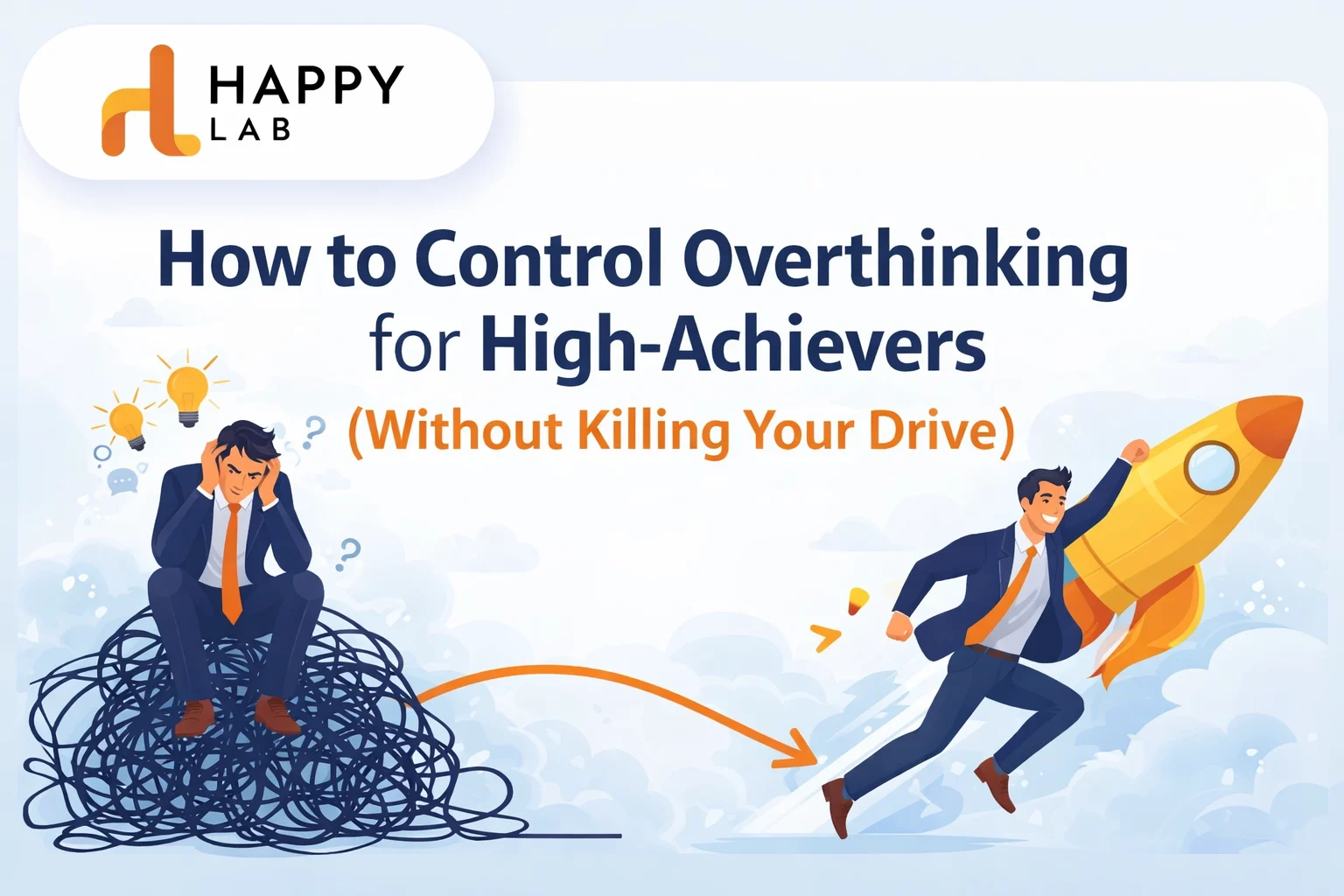
How to Control Overthinking for High-Achievers (Without Killing Your Drive)
If you’re a high-achiever, let’s be real you don’t overthink because you’re weak.
You overthink because you care.
You want to win, improve, stay ahead, and avoid mistakes. You replay decisions, analyze outcomes, and plan ten steps ahead. On the surface, it looks like ambition.
But underneath?
It’s mental exhaustion.
The same mind that helps you succeed can also trap you in constant analysis. The line between strategic thinking and overthinking becomes blurred.
This guide is specifically for people like you, driven, focused, and ambitious who want to learn how to control overthinking without losing their edge.
Overthinking in High Performers
Let’s call it what it is.
High-achievers don’t just think they over-process.
You:
- Analyze every decision
- Replay conversations for improvement
- Constantly ask “what’s next?”
- Struggle to switch off
It’s not random. It’s training.
Your success came from thinking deeply. But now, your brain doesn’t know when to stop.
Why High-Achievers Overthink More
Here’s the truth most people won’t say:
👉 Overthinking is a side-effect of ambition
Top reasons:
- Fear of losing momentum
- High expectations from self
- Need for control
- Past wins reinforcing analysis
- Identity tied to performance
You don’t just want success, you want certainty.
And that’s where overthinking starts.
The Hidden Cost of Overthinking
At first, it feels productive.
But over time, it becomes a bottleneck.
Cost Breakdown
Area | Impact |
Decision-making | Slower |
Creativity | Reduced |
Sleep | Disrupted |
Confidence | Shaken |
Execution | Delayed |
👉 The biggest loss?
You stop taking fast action.
And in high performance, speed matters.
Anxiety and Overthinking in Success-Oriented Minds
High-achievers often hide anxiety behind productivity.
You stay busy. You keep working. But internally?
There’s pressure.
Cycle
- High expectation
- Overthinking
- Anxiety
- More control attempts
- More overthinking
Breaking this cycle is critical not just for mental health, but for sustained performance.
Strategic Thinking vs Overthinking
Let’s draw a sharp line.
Comparison Table
Strategic Thinking | Overthinking |
Focused | Scattered |
Time-bound | Endless |
Action-driven | Fear-driven |
Clear outcome | Confusion |
Moves forward | Stuck |
Rule:
If thinking doesn’t lead to action, it’s overthinking.
The High-Achiever Overthinking Cycle
This is how it usually goes:
- You set a big goal
- You plan deeply
- You overanalyze risks
- You delay action
- You feel pressure
- You think more
And repeat.
How to Control Overthinking Without Losing Performance
You don’t need to “stop thinking.”
You need to structure thinking.
Core Principle
👉 Think less, execute more, review smarter
Action Steps
- Set time limits for thinking
- Decide with available data
- Accept imperfect action
- Review after execution
The 3-Level Thinking Framework
Use this simple system:
Level 1: Thinking (Max 20%)
- Analyze
- Plan
Level 2: Execution (60%)
- Take action
- Test
Level 3: Review (20%)
- Learn
- Adjust
👉 Most overthinkers spend 80% in Level 1.
Shift it.
Decision-Making Without Overanalysis
High-achievers struggle here the most.
Use the 70% Rule
If you have:
- 70% clarity
- Enough data
👉 Make the decision.
Decision Table
Situation | Action |
Small decision | Decide instantly |
Medium decision | Think 10–15 mins |
Big decision | Think 1–2 days max |
Building Mental Discipline
Overthinking is not just emotional, it’s a discipline issue.
Train Your Mind Like a Muscle
- Set thinking limits
- Catch repetitive thoughts
- Shift to action
👉 Discipline reduces mental noise.
Managing Perfectionism
Let’s be blunt.
Perfectionism is disguised overthinking.
Replace This:
- “It must be perfect”
With This:
- “It must be done”
Execution Formula
Done > Perfect
High-Performance Routine to Reduce Overthinking
Structure kills overthinking.
Daily Routine
Time | Activity |
Morning | Exercise + planning |
Work Blocks | Deep work |
Breaks | Reset |
Evening | Reflection |
Night | No screens |
When to Seek Professional Support
Even high performers need help.
If you:
- Can’t switch off your mind
- Feel constant pressure
- Experience anxiety
👉 It’s time.
Platforms like Happy Lab – online mental health counseling provide:
- Performance-focused therapy
- Mental clarity tools
- Structured guidance
Daily Mental Reset System
Use this daily.
Morning
- Set 3 priorities
Midday
- Check progress
Night
- Write:
- What worked
- What didn’t
- What worked
This prevents mental buildup.
Conclusion + Execution Blueprint
Let’s cut through everything.
You don’t have an overthinking problem.
You have an unstructured thinking system.
Execution Blueprint (Save This)
1. Daily Rules
- Think with limits
- Act fast
- Review daily
2. Weekly System
- Identify overthinking triggers
- Fix decision delays
3. Mindset Shift
- Action creates clarity
- Thinking does not
4. If You Feel Stuck
- Talk it out
- Get expert help
- Use platforms like Happy Lab – counselling therapy in india
High-Achiever Reminder
- Your strength is thinking
- Your weakness is overthinking
- Your solution is structured action
Final Thought
You don’t win by thinking more.
You win by executing better.
Also Read : Anxiety and Overthinking: How to Break the Cycle? A Guide to Calming Your Mind
FAQ'S
Why do high-achievers overthink more?
Because they are highly invested in outcomes and want control over results.
How to control overthinking without losing performance?
Structure your thinking, limit analysis time, and focus more on execution.
Is overthinking a sign of intelligence?
Sometimes, but unmanaged overthinking reduces performance.
Can therapy help high performers?
Yes, especially structured therapy like Happy Lab – counselling therapy in india.
What is the fastest way to stop overthinking?
Shift immediately into action movement breaks the loop.