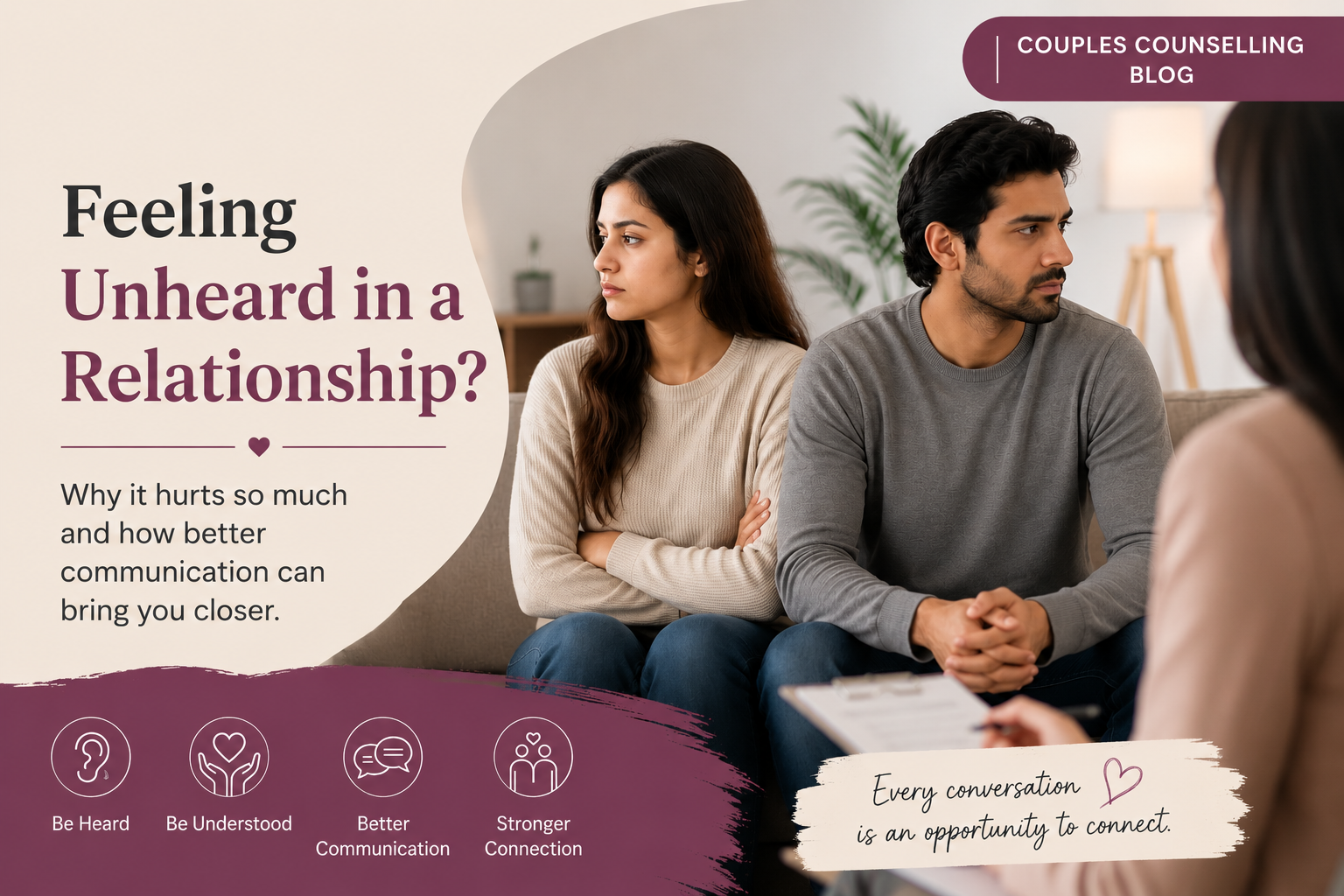
“I keep telling you the same thing, but you never listen.”
“What’s the point of explaining anymore?”
If you’ve ever found yourself saying these words—or hearing them from your partner—you’re not alone.
One of the most painful experiences in a relationship isn’t always betrayal, anger, or conflict. Sometimes, it’s the quiet feeling of being unheard.
As a couples therapist, I’ve seen this pattern in countless relationships. Most couples don’t stop talking because they have nothing left to say. They stop talking because they begin to believe that saying anything won’t make a difference.
And that is where distance quietly begins.
Why Feeling Unheard Hurts So Much
When you communicate something important, you’re doing much more than sharing information.
You’re sharing your fears, your needs, your disappointments, your hopes, and your expectations. You’re allowing someone to see a vulnerable part of you.
When your partner ignores it, dismisses it, or doesn’t acknowledge it, it doesn’t just feel like they missed your words.
It feels like they missed you.
After this happens repeatedly, people slowly stop trying.
They think:
“Why should I explain it again?”
“Nothing changes anyway.”
Over time, conversations become shorter. Difficult topics are avoided. Silence replaces honesty.
And often, that silence becomes the beginning of emotional distance in an otherwise good relationship.
Listening vs Understanding: What’s the Difference?
One of the biggest misunderstandings I see in therapy is this:
Many people believe that because they listened, they understood.
But those are two very different things.
You can sit quietly, hear every single word your partner says, and still completely miss what they actually meant.
Understanding means that you don’t just hear the words—you understand the emotion behind them.
More importantly, understanding changes your behaviour.
The next time a similar situation comes up, you respond differently because you understood what mattered to your partner.
A simple way to think about it is this:
If you understand what an apple is, every time you see one, you instantly recognise it.
But if you’ve only memorised the word “apple” without understanding what it actually is, seeing the fruit won’t mean much.
Relationships work the same way.
It’s not about remembering your partner’s words.
It’s about understanding the meaning behind them.
According to the American Psychological Association (APA), active listening involves paying full attention, understanding the speaker’s perspective, and responding thoughtfully rather than simply hearing the words.
Why Partners Become Defensive During Arguments
Most people don’t enter an argument wanting to hurt their partner.
They enter wanting to protect themselves.
That’s simply human nature.
When we feel criticised, misunderstood, or blamed, our brain immediately shifts into defence mode.
Instead of asking,
“What is my partner trying to tell me?”
we begin thinking,
“How do I prove I’m right?”
That’s when conversations stop becoming about solving a problem.
They become about winning.
And this doesn’t only happen in romantic relationships.
It happens with friends, parents, colleagues, and even bosses.
When we’re busy protecting ourselves, we leave very little room to truly understand someone else.
Why Emotional Validation Matters in Every Relationship
One thing almost every person longs for in a relationship is validation.
Not constant praise.
Just acknowledgment.
Maybe your partner planned a surprise for you.
Maybe they’ve been listening to your stressful workdays every evening.
Maybe they’re trying to change a habit that’s difficult for them.
Sometimes all they’re hoping to hear is:
“I noticed your effort.”
“Thank you.”
“I know this wasn’t easy for you.”
These small moments of appreciation often strengthen relationships far more than grand romantic gestures.
Feeling seen makes people want to keep showing up for each other.
How to Tell Your Partner You Feel Unheard
Whenever you’re bringing up something that has hurt you, don’t just explain the problem.
Explain your intention.
Instead of saying,
“You never listen to me.”
Try saying something like:
“I’m bringing this up because I want us to understand each other better. I’m not trying to blame you or start another fight. I want us to have a healthier relationship.”
This small shift changes the emotional tone of the conversation.
Your partner no longer has to guess why you’re bringing it up.
It reduces defensiveness because they understand your goal isn’t to attack them—it’s to strengthen the relationship.
When Should You Consider Couples Counselling?
Every couple gets stuck sometimes.
It’s completely normal to have recurring disagreements.
But if you find yourselves discussing the same issue repeatedly, trying different solutions, making promises, and still ending up in the exact same place, it may be time for an outside perspective.
A couples therapist doesn’t decide who’s right or wrong.
Instead, they help uncover why the solutions aren’t working in the first place.
Sometimes the issue isn’t communication.
Sometimes it’s assumptions, unresolved emotions, old relationship patterns, or needs that neither partner has fully understood.
Having someone guide those conversations can help couples move forward instead of going around in circles.
Signs You Feel Unheard in a Relationship
- You repeat yourself but nothing changes.
- Your partner immediately becomes defensive.
- You avoid bringing up important topics.
- You feel emotionally lonely despite being together.
- Conversations end in arguments instead of understanding.
How to Make Your Partner Feel Heard?
- Listen without interrupting.
- Reflect back what you heard.
- Validate emotions before solving.
- Ask questions instead of assuming.
- Appreciate their effort.
Feeling unheard isn’t just about someone missing your words.
It’s about feeling that your emotions, experiences, and needs don’t matter.
The good news is that relationships rarely improve because people become better speakers.
They improve because people become better at understanding.
When both partners feel heard, understood, and validated, conversations become less about defending themselves and more about solving problems together.
And often, that’s where real connection begins.
About the Author
Vandana is the lead counsellor and the Founder of Happy Lab. Over the past six years, she has worked with individuals and couples across 2,000+ therapy sessions, helping them understand recurring emotional and relationship patterns through evidence-based approaches such as ACT and the Gottman Method.