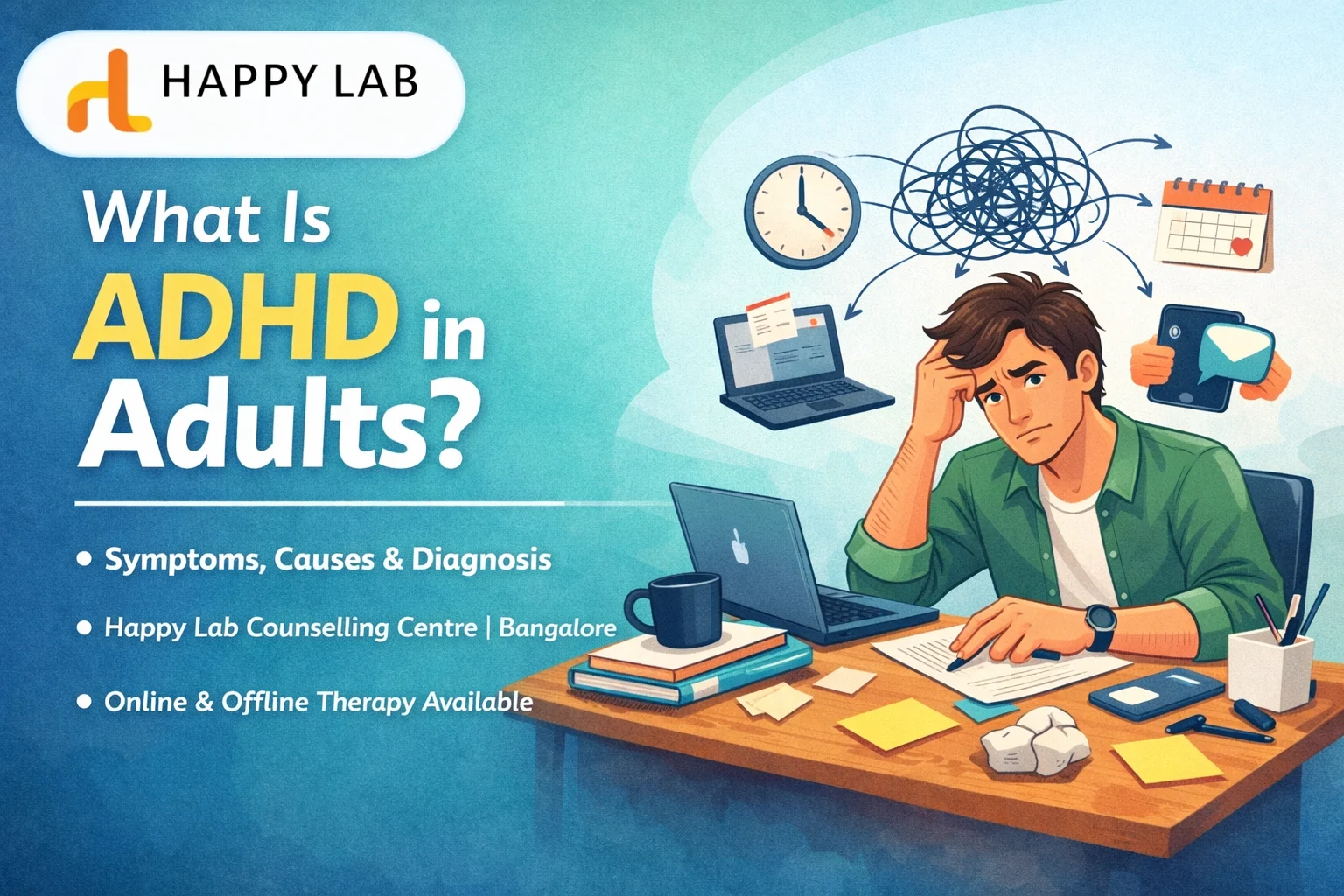
What Is ADHD in Adults? Symptoms, Causes & Diagnosis Explained – Happy Lab
Have you ever entered a room and fully forgot the reason you went into that room? Or did you find yourself going on five tasks and not completing any of them? Perhaps your head is busy as it always seems to be with the many browser tabs.
In the case that sounds like you are familiar, you may be wondering: what is ADHD in adults?
The prevalence of adult ADHD is much greater than one would expect. It is common in Bangalore and other areas in India to have many adults living undiagnosed with ADHD over many years, thinking they are just bad time managers, or too sensitive or not disciplined enough.
This guide identifies the symptoms of ADHD in adults, its causes, diagnosis, and the importance of seeking professional assistance in Happy Lab Counselling Centre in Bangalore that provides in person counselling sessions and secure online counselling in order to restore clarity, organization and confidence in yourself.
Quick Answer: What Is ADHD in Adults?
In adults, ADHD is a neurodevelopmental disorder, which can impact resistance to impulsive behaviour, attention, organisation, and emotions. It is neither a character defect nor a weakness of the character. It is a manifestation of the disparities in brain attention and executive functioning management.
Common adult ADHD symptoms include:
- Difficulty sustaining focus
- Forgetfulness
- Procrastination
- Restlessness (often internal)
- Impulsive decision making
- Emotional sensitivity
A diagnosis requires a comprehensive clinical evaluation conducted by a qualified mental health professional.
Signs and Symptoms of ADHD in Adults
According to the DSM 5, ADHD presents in three patterns:
Predominantly Inattentive
Predominantly Hyperactive Impulsive
Combined Presentation
In adults, symptoms often look different from childhood ADHD. Many people, particularly women, remain undiagnosed because their symptoms don’t match the stereotypical image of a hyperactive child.
1. Predominantly Inattentive Presentation
This form is frequently overlooked, especially in women. There may be no obvious physical restlessness. Instead, the person may appear quiet, distracted, or disengaged.
Common signs include:
Difficulty completing tasks
Frequently misplacing important items
Forgetting appointments
Getting sidetracked by unrelated thoughts
Sometimes referred to informally as “quiet ADHD,” it is often mistaken for anxiety, low motivation, or poor planning skills.
2. Predominantly Hyperactive Impulsive Presentation
In adults, hyperactivity often becomes internal rather than physical.
You might:
Feel mentally “on the go” even when sitting still
Struggle to relax
Talk excessively
Experience a constant sense of urgency
3. Impulsivity
Impulsivity may show up as:
Interrupting others mid conversation
Making sudden financial decisions
Starting new projects before completing old ones
Reacting emotionally without pausing
Not everyone experiences all three patterns equally. Symptoms may shift depending on life stage and environment.
Emotional & Associated Features of ADHD
While not part of the formal diagnostic criteria, many adults with ADHD report emotional patterns such as:
- Sudden mood shifts
- Low frustration tolerance
- Sensitivity to criticism
- Persistent self doubt despite competence
For example, mild feedback at work may trigger intense thoughts like, “I’m not good enough.”
This emotional intensity is not a weakness. It is a commonly observed pattern and one that can be addressed effectively in therapy.
Causes of ADHD in Adults
Research consistently shows a strong genetic component. ADHD tends to run in families more strongly than most neurodevelopmental conditions.
Brain imaging studies indicate differences in areas responsible for attention and executive functioning. At a neurochemical level, ADHD involves differences in dopamine and norepinephrine regulation, which influence focus, motivation, and impulse control.
What ADHD is not caused by:
- Poor parenting
- Lack of discipline
- Excessive screen time
- Personal weakness
Examples of Adult ADHD
Example 1: The Corporate Professional
Rohan works in IT in Bangalore. He is creative and capable but regularly misses deadlines and procrastinates until pressure becomes overwhelming. His manager assumes he lacks discipline.
After a structured evaluation, he learns he has ADHD (Predominantly Inattentive). With therapy and structured planning tools, his performance improves significantly.
Example 2: The Entrepreneur
Priya constantly generates innovative ideas. She launches multiple projects but rarely completes them. The gap between her potential and her output creates anxiety and self criticism.
Through counselling, she recognises that her execution challenges are linked to ADHD not a lack of intelligence or ambition.
ADHD in Working Professionals
In fast paced environments like Bangalore’s corporate and startup ecosystem, ADHD symptoms can affect:
- Time management
- Task prioritisation
- Meeting deadlines
- Workplace communication
Many adults develop coping strategies that work until life demands exceed their capacity.
Professional counselling at Happy Lab supports working professionals in understanding their patterns, reducing burnout, and building practical systems aligned with how their brain functions.
ADHD and Relationships
ADHD can impact relationships in subtle but significant ways:
- Forgetting important dates
- Zoning out during conversations
- Emotional overreactions
- Impulsive arguments
Partners may interpret these behaviours as carelessness rather than neurological differences. Therapy can help improve communication, emotional regulation, and mutual understanding.
How Is ADHD Diagnosed in Adults?
- Detailed clinical interview
- Symptom history (symptoms must have been present before age 12 as per DSM 5)
- Standardised ADHD rating scales
- Screening for other conditions (anxiety, depression, sleep disorders, thyroid issues)
Treatment Options for Adult ADHD
Most adults benefit from a combination of approaches.
Therapy
Acceptance and Commitment Therapy (ACT) and structured ADHD focused therapy help with:
Organisational skills
Emotional regulation
Cognitive restructuring
Self esteem rebuilding
Skill Based Coaching
Practical support with:
Time management
Task initiation
Planning systems
Medication
For some adults, medication significantly improves focus and impulse control. This requires psychiatric consultation.
Lifestyle Adjustments
Consistent sleep, exercise, reduced multitasking, and structured routines meaningfully reduce symptom intensity.
Therapy at Happy Lab Counselling Centre, Bangalore
Happy Lab is a professional counselling centre in Bangalore offering:
- ADHD assessment and therapy
- Anxiety and depression counselling
- Relationship counselling
- Burnout support
- Therapy for high performing professionals
Sessions are available both offline in Bangalore and through secure online counselling across India.
When Should You Seek Help?
Consider professional support if:
- Your work performance is suffering
- Relationships feel strained
- You feel chronically overwhelmed
- Self esteem is declining
Early intervention can prevent long term stress, burnout, and self blame.
Daily Strategies to Manage ADHD
While therapy addresses deeper patterns, daily tools can help:
- Calendar blocking
- Task transition alarms
- The 2 minute rule for small tasks
- Visual planners
- Reducing multitasking
Small structure often creates greater freedom.
Strengths and ADHD
Some adults with ADHD report strengths linked to their neurotype:
- Creative thinking
- High energy
- Hyperfocus on meaningful tasks
- Empathy
Acknowledging strengths does not dismiss challenges. Therapy aims to reduce impairment while allowing strengths to thrive.
ADHD in adults is not immaturity. It is not laziness. not a lack of willpower.
It is a diagnosable and treatable neurodevelopmental difference affecting attention, impulse control, and executive functioning.
With appropriate support, adults with ADHD can build sustainable systems, strengthen relationships, and thrive professionally.
If you recognise yourself in these patterns, you do not have to navigate them alone. Understanding is possible. Change is achievable. Support is available.
FAQ'S
What is ADHD in adults?
What are common adult ADHD symptoms?
Forgetfulness, difficulty sustaining focus, procrastination, internal restlessness, impulsive decisions, and emotional sensitivity.
How is ADHD diagnosed in adults?
Through a comprehensive clinical evaluation including detailed history, childhood symptom review (before age 12), psychological assessments, and ruling out other conditions.
Can ADHD affect relationships?
Yes. It can influence communication, emotional responses, and reliability in ways that may be misunderstood.
Where can I get ADHD counselling in Bangalore?
You can seek support at Happy Lab Counselling Centre in Bangalore, offering both in person therapy and secure online sessions across India.
Can someone have ADHD without being hyperactive?
Yes. The inattentive presentation often called “quiet ADHD” does not include obvious hyperactivity and is commonly missed in adults.
Is ADHD the same as laziness?
No. ADHD involves genuine difficulty regulating attention despite effort and motivation.
Does Happy Lab prescribe ADHD medication?
No. As a counselling psychology centre, Happy Lab provides therapy and assessment. Medication requires psychiatric evaluation.
How do I know if I need ADHD counselling?
If ongoing patterns are affecting your work, relationships, or sense of self, a professional evaluation can provide clarity and direction.